



Hey there! As a supplier of ECG Trunk Cables, I often get asked about the mechanical strength of these cables. So, I thought I'd take a moment to break it down for you.
First off, let's talk about what an ECG Trunk Cable actually is. In simple terms, it's a crucial part of an electrocardiogram (ECG) system. It connects the patient to the ECG monitor, transmitting the electrical signals from the patient's heart so that healthcare providers can analyze them.
Now, onto the mechanical strength. The mechanical strength of an ECG Trunk Cable refers to its ability to withstand physical stress and wear and tear without breaking or malfunctioning. This is super important because these cables are used in a variety of clinical settings, where they might be pulled, bent, twisted, or stepped on.
One of the key factors that contribute to the mechanical strength of an ECG Trunk Cable is the materials used in its construction. High - quality cables are typically made with durable outer sheaths. These sheaths are often made of materials like PVC (polyvinyl chloride) or TPE (thermoplastic elastomer). PVC is known for its toughness and resistance to abrasion, while TPE offers flexibility along with good mechanical properties.
The internal conductors also play a big role. They need to be strong enough to maintain their integrity even when the cable is flexed. Copper is a commonly used material for the conductors because it's a great electrical conductor and has relatively good mechanical strength.


Another aspect is the cable's design. Well - designed cables have proper strain relief at the connection points. Strain relief helps to distribute the stress evenly along the cable, preventing it from concentrating at the joints and causing damage. For example, when you plug the cable into the ECG monitor or the patient leads, the strain relief ensures that the pulling force doesn't directly affect the internal connections.
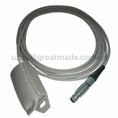
Let's take a look at some of the products we offer. We have the SC9000 XL Multi - Link Trunk Cable ( Spo2 , Temperature , ECG ). This cable is built with high - quality materials to ensure excellent mechanical strength. It can handle the day - to - day rigors of a busy healthcare environment, whether it's in a hospital ward, an emergency room, or a doctor's office.
Our Use with Datex 545300 3 - lead ECG Trunk Cable,AHA/IEC ,Round 10PIN Female,with 4.7K Resistance is another great option. It's designed to be robust and reliable, with a strong outer sheath and well - protected internal conductors. This cable is suitable for use with specific Datex equipment, and its mechanical strength ensures a long service life.
If you're using Drager equipment, our ECG Multi - Link Trunk Cable for Drager is a top - notch choice. It's engineered to fit perfectly with Drager monitors and has been tested to withstand the physical demands of clinical use.
When it comes to testing the mechanical strength of our ECG Trunk Cables, we follow strict standards. We perform bending tests, where the cable is bent back and forth a certain number of times to simulate real - world use. We also conduct tensile tests to measure how much pulling force the cable can withstand before breaking.
In addition to the physical construction and testing, proper handling and maintenance also affect the mechanical strength of the cables. Healthcare providers should be trained to handle the cables correctly. For example, they should avoid yanking the cables out of the connectors and should store them properly when not in use.
Over time, even the most durable cables will experience some wear. That's why it's important to regularly inspect the cables for any signs of damage, such as cuts, fraying, or exposed conductors. If any damage is detected, the cable should be replaced immediately to ensure accurate ECG readings and patient safety.
So, if you're in the market for ECG Trunk Cables, you need to consider the mechanical strength. A cable with high mechanical strength will save you money in the long run because you won't have to replace it as often. It will also provide reliable performance, which is crucial in a healthcare setting where accurate ECG data can make a big difference in patient care.
If you're interested in learning more about our ECG Trunk Cables or would like to discuss your specific requirements, feel free to reach out. We're here to help you find the best cables for your needs. Whether you're a small clinic or a large hospital, we have the products and expertise to meet your demands.
References:
- Industry standards for medical cable manufacturing
- Research on materials used in medical cable construction