


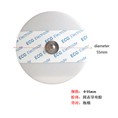
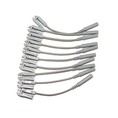


Products Description
High - Quality EKG cable for Zoll defibrillator
Compatible Zoll 15Pin ECG EKG Cable with 10 leadwires for M series and E series, IEC/ Grabber
An electrocardiogram (ECG) is a simple test that can be used to check your heart' s rhythm and electrical activity. Sensors attached to the skin are used to detect the electrical signals produced by your heart each time it beats.
Description
Product Name: Direct-Connect EKG Cable with leadwires
OEM/ODM: Yes
♦ Compatible brand:Zoll
♦ Compatible model: This is a one-piece, molded compatible Zoll 1 Step Patient Cable for E Series and M Series defibrillators. Includes trunk cable and limb and V leads. 11 foot cable.
OEM#: 8000-1007-01, 8000-1007-02

Specification
| Type | EKG cable |
| Connector | 15 pin |
| Patient side | 10 leadwires, Grabber |
| Length | 3.4m |
| Material | Medical TPU |
| Type | AHA/ IEC, Snap/ Clip/ din 3.0/ banana 4.0 are available |
| Warranty | 6 months |
Ambient temperature: 0 - 40 °C (32 - 104 °F)
Relative humidity: 0 % - 80 %
Hyperbaric pressure: 86 kPa - 106 kPa
Materials: Quality TPU jacket cable, 2.5 m + 0.9 m length, gray; Medical PVC strain relief; Gold - plated pins and nylon plug
Product Advantages
1. Integrated plug connector, solid and easy to clean;
2. The color code of the electrode connector, easy to read and use;
3. Excellent shielding performance and anti-interference performance, better signal quality.
features
- High - quality material: The cable is made of high - quality TPU material, which is non - toxic, anti - interference, soft and durable. It can ensure stable operation in a certain temperature and humidity range.
- Compliance with standards: It complies with ISO 13485. IEC and AHA color - coding are available, which helps to ensure the accuracy and reliability of the product in use.
- Diverse options: There are different length options to meet different usage scenarios and requirements. Fixed one - piece ECG cables and detachable lead sets with pinch and snap ends are available, and the product is latex - free, which is convenient for cleaning and repair.
- Good performance: The gold - plated pins and nylon plug are adopted to ensure good conductivity and connection stability. The medical PVC strain relief can protect the cable from damage and prolong its service life.
Picture


Electrode Placement
Depending on local usage, ECG lead wires are marked with certain labels. Refer to the following table for labels and color codes for the different lead sets.
| Location | AHA Labels | IEC Labels |
| Right Arm | RA (white) | R (red) |
| Left Arm | LA (black) | L (yellow) |
| Right Leg | RL (green) | N (black) |
| Left Leg | LL (red) | F (green) |
| Chest | V1 | C1 |
| Chest | V2 | C2 |
| Chest | V3 | C3 |
| Chest | V4 | C4 |
| Chest | V5 | C5 |
| Chest | V6 | C6 |
Proper skin preparation and use of proper electrodes are very important for good signal quality.
If necessary, prepare the patient's skin for electrode application by:
• Shaving or clipping excess hair at electrode site.
• Cleaning oily skin with an alcohol pad.
• Rubbing site briskly to dry.
• Avoiding placing electrodes over tendons and major muscle masses.
Place electrodes on the patient. All electrodes must be connected.
When acquiring 12-lead ECG from quiet supine patients, we recommends placing the limb electrodes anywhere along the ankles and wrists. When it is difficult for the patient to remain motionless due to
shivering, muscle tremors, or transport vehicle movement, place limb electrodes on patient' s thorax for better results. (Refer to the following two diagrams for limb electrode placement).

Place the precordial electrodes across the chest in the following locations:
V1: Fourth intercostal space, at the patient' s right sternal margin.
V2: Fourth intercostal space, at the patient' s left sternal margin.
V3: Fifth rib, between leads V2 and V4.
V4: Fifth intercostal space, on the patient' s midclavicular line.
V5: Patient' s left anterior axillary line, at the horizontal level of V4.
V6: Patient' s left midaxillary line, at the same horizontal level as V4 and V5
Locating the V1 position (fourth intercostal space) is critically important because it is the reference point for locating the placement of the remaining V-leads. To locate the V1 position:
1. Place your finger on top of the jugular notch (see figure below).
2. Move your finger slowly downward about 1.5 inches (3.8 centimeters) until you feel a slight horizontal ridge or elevation. This is the "Angle of Louis," where the manubrium joins the body of the sternum.
3. Locate the second intercostal space on the patient' s right side, lateral to and just below the "Angle of Louis."
4. Move your finger down two more intercostal spaces to the fourth intercostal space which is the V1 position.
Note: When placing electrodes on female patients, always place leads V3-V6 under the breast rather
than on the breast.

FAQ
What are ECG cables?
ECG leads provide connection between patient applied electrodes and various telemetry and bedside monitoring units allowing for non-invasive monitoring of electrical impulses generated by the heart over a period of time resulting in an electrocardiogram.
What are ECG cables made of?
ECG cables and ECG lead wires are made using materials such as thermoplastic elastomer (TPE), thermoplastic polyurethane (TPUA), PVC or silicone. TPE has been the main material used due to its durability, strength, and compatibility in addition to providing safety and comfort to patients.
What is the difference between and ECG and EKG?
There is no difference between an ECG and an EKG. Both refer to the same procedure, however one is in English (electrocardiogram – ECG) and the other is based on the German spelling (elektrokardiogramm – EKG). It is common to use the German "EKG" in the United States because "ECG" sounds very similar to a different procedure called an EEG.
An ECG/EKG is a procedure for recording electrical activity in the heart over a period of time using electrodes that are strategically placed on the body. The most common EKG is called the 12-lead EKG.
Hot Tags: High - Quality EKG cable for Zoll defibrillator, China, manufacturers, customized, bulk, buy discount, low price, high quality, leadwire cable for electrocardiogram in clinics, ecg cable for physicians, diagnostic cable with leadwires for ekg in hospitals, ekg leadwire cable in patient monitoring, diagnostic cable for ekg for physicians, ekg leadwire cable in heart function testing


