


When it comes to the field of medical equipment, Bulk ECG Trunk Cables play a crucial role in ensuring accurate and reliable electrocardiogram (ECG) signal transmission. As a supplier of Bulk ECG Trunk Cables, I often receive inquiries about various aspects of these cables, and one question that frequently comes up is: What is the cross - sectional area of a Bulk ECG Trunk Cable?
Understanding the Cross - Sectional Area
The cross - sectional area of a cable is essentially the area of the slice that you would get if you were to cut the cable perpendicular to its length. In the context of a Bulk ECG Trunk Cable, this area is a significant parameter that influences several key performance characteristics.
Mathematically, for a cable with a circular cross - section (which is common in many Bulk ECG Trunk Cables), the cross - sectional area (A) can be calculated using the formula (A=\pi r^{2}), where (r) is the radius of the cable's core. For non - circular cross - sections, more complex geometric calculations are required, often involving integral calculus for irregular shapes. However, most Bulk ECG Trunk Cables are designed with circular or near - circular cross - sections for ease of manufacturing and consistent electrical properties.
Importance of Cross - Sectional Area in Bulk ECG Trunk Cables
Electrical Resistance
One of the most important impacts of the cross - sectional area is on the electrical resistance of the cable. According to Ohm's law, the resistance (R) of a conductor is given by the formula (R = \rho\frac{l}{A}), where (\rho) is the resistivity of the material, (l) is the length of the cable, and (A) is the cross - sectional area. A larger cross - sectional area means lower resistance. In the case of Bulk ECG Trunk Cables, lower resistance is desirable because it reduces power loss during signal transmission. This is crucial for maintaining the integrity of the ECG signals, as any power loss can lead to signal attenuation and distortion. For example, if the resistance is too high, the weak ECG signals may not reach the monitoring device with sufficient strength, resulting in inaccurate readings.
Signal Transmission Quality
The cross - sectional area also affects the cable's ability to transmit signals without interference. A cable with an appropriate cross - sectional area can better shield against electromagnetic interference (EMI). EMI can be a significant problem in a medical environment, where there are many electronic devices operating simultaneously. By having a proper cross - sectional area, the cable can be designed with better shielding materials and geometries, reducing the impact of external electromagnetic fields on the ECG signals.
Heat Dissipation
During operation, electrical currents flowing through the cable generate heat. The cross - sectional area plays a role in heat dissipation. A larger cross - sectional area allows for more efficient heat transfer from the cable's core to the surrounding environment. This is important because excessive heat can damage the cable's insulation and other components, leading to premature failure. In a Bulk ECG Trunk Cable, maintaining a proper temperature is essential for long - term reliability.
Factors Influencing the Choice of Cross - Sectional Area
Signal Requirements
The specific requirements of the ECG signals being transmitted are a major factor in determining the cross - sectional area. Different ECG monitoring devices may have different sensitivity levels and signal strength requirements. For example, high - precision monitoring devices may require cables with larger cross - sectional areas to ensure accurate signal transmission.
Cable Length
The length of the Bulk ECG Trunk Cable also affects the choice of cross - sectional area. As the length of the cable increases, the resistance also increases according to the formula (R = \rho\frac{l}{A}). To compensate for the increased resistance, a larger cross - sectional area may be needed for longer cables to maintain acceptable signal quality.
Cost and Manufacturing Constraints
Cost is always a consideration in the manufacturing process. Larger cross - sectional areas often require more material, which can increase the cost of production. Manufacturers need to strike a balance between the desired electrical performance and the cost of the cable. Additionally, manufacturing constraints such as the available machinery and production techniques can also limit the range of cross - sectional areas that can be produced efficiently.
Our Product Offerings
As a supplier of Bulk ECG Trunk Cables, we offer a wide range of products with different cross - sectional areas to meet the diverse needs of our customers. Our cables are designed using high - quality materials and advanced manufacturing techniques to ensure optimal performance.
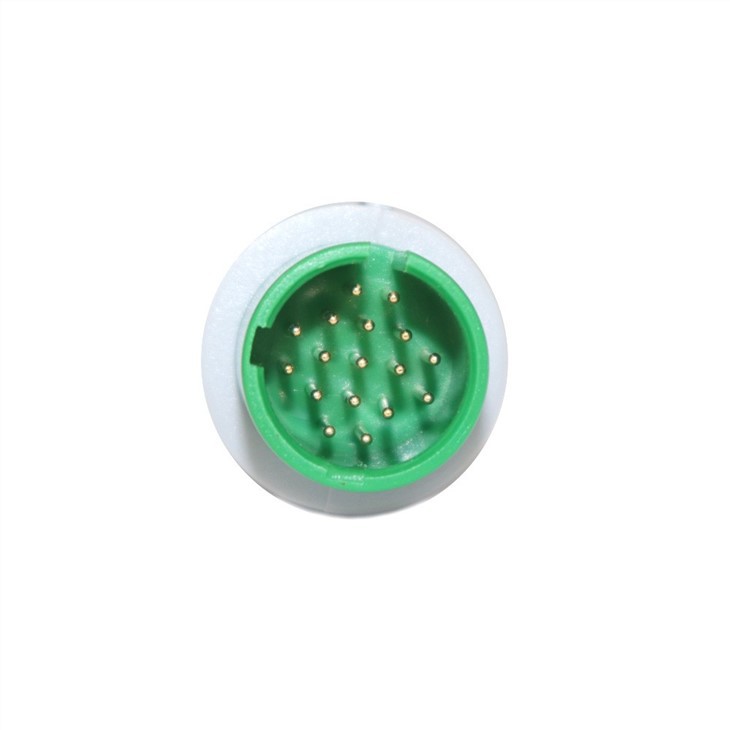
For example, we have the ECG Cable Compatible With GE Dash, tram, solar Series 5 - lead. This cable is specifically designed to be compatible with GE's popular monitoring systems. It has been carefully engineered with an appropriate cross - sectional area to provide reliable signal transmission and excellent EMI shielding.

Another product in our portfolio is the Multifunction Therapy Cable for ZOLL. This cable not only transmits ECG signals but also supports other functions, such as defibrillation therapy. The cross - sectional area of this cable is designed to handle the higher currents associated with defibrillation while still maintaining the integrity of the ECG signals.
We also offer the TruLink DIN Neonatal ECG Cable For Spacelabs. Neonatal ECG monitoring requires high - precision and low - interference cables. Our cable for Spacelabs is designed with a carefully selected cross - sectional area to meet the unique requirements of neonatal patients, ensuring accurate and reliable monitoring.
Conclusion
The cross - sectional area of a Bulk ECG Trunk Cable is a critical parameter that affects its electrical performance, signal transmission quality, and overall reliability. Understanding the importance of cross - sectional area and the factors that influence its choice is essential for both manufacturers and end - users. As a supplier, we are committed to providing high - quality Bulk ECG Trunk Cables with the appropriate cross - sectional areas to meet the specific needs of our customers.
If you are in the market for Bulk ECG Trunk Cables or have any questions about our products, we encourage you to contact us for a detailed discussion. Our team of experts is ready to assist you in finding the right cable solutions for your medical monitoring needs.
References
- Halliday, D., Resnick, R., & Walker, J. (2014). Fundamentals of Physics. Wiley.
- Sadiku, M. N. O. (2014). Elements of Electromagnetics. Oxford University Press.
- Hayt, W. H., & Buck, J. A. (2014). Engineering Electromagnetics. McGraw - Hill.