


When it comes to the field of medical equipment, Bulk ECG Trunk Cables play a crucial role in the accurate transmission of electrocardiogram (ECG) signals. As a supplier of Bulk ECG Trunk Cables, I often encounter questions from customers regarding various technical aspects of these cables, and one of the frequently asked questions is about the capacitance of a Bulk ECG Trunk Cable. In this blog, I will delve into the concept of capacitance in relation to Bulk ECG Trunk Cables, explain its significance, and discuss how it impacts the performance of these cables.
Understanding Capacitance
Capacitance is a fundamental electrical property that measures the ability of a component or system to store electrical energy in an electric field. In the context of a Bulk ECG Trunk Cable, capacitance refers to the cable's ability to store electrical charge between its conductors. The capacitance of a cable is influenced by several factors, including the physical dimensions of the cable, the materials used in its construction, and the spacing between the conductors.
Mathematically, capacitance (C) is defined as the ratio of the electric charge (Q) stored on a conductor to the potential difference (V) across it, expressed as C = Q/V. The unit of capacitance is the farad (F), but in practical applications, capacitances are often measured in picofarads (pF) or nanofarads (nF) due to the relatively small values involved.
Factors Affecting the Capacitance of a Bulk ECG Trunk Cable
Physical Dimensions
The physical dimensions of a Bulk ECG Trunk Cable, such as its length, diameter, and the number of conductors, have a significant impact on its capacitance. Generally, longer cables tend to have higher capacitance because there is more surface area available for charge storage. Similarly, cables with larger diameters or more conductors may also exhibit higher capacitance due to the increased amount of material and the larger electric field generated between the conductors.
Dielectric Material
The dielectric material used in the insulation of the cable conductors also plays a crucial role in determining the cable's capacitance. Dielectric materials are non-conductive substances that separate the conductors and prevent electrical leakage. Different dielectric materials have different dielectric constants, which is a measure of their ability to store electrical energy. Materials with higher dielectric constants will result in higher capacitance values for the cable.
Conductor Spacing
The spacing between the conductors in a Bulk ECG Trunk Cable affects the electric field distribution and, consequently, the capacitance. Closer spacing between the conductors increases the capacitance because the electric field is stronger in the region between them. Conversely, wider spacing reduces the capacitance by weakening the electric field.
Significance of Capacitance in Bulk ECG Trunk Cables
Signal Transmission
Capacitance can have a significant impact on the transmission of ECG signals through a Bulk ECG Trunk Cable. ECG signals are low-frequency electrical signals that carry information about the heart's electrical activity. When these signals pass through a cable with high capacitance, the cable acts as a capacitor, which can cause signal distortion and attenuation.
Signal distortion occurs because the capacitor charges and discharges in response to the changing ECG signal, introducing a phase shift and altering the shape of the signal. Attenuation, on the other hand, refers to the reduction in the amplitude of the signal as it travels through the cable. High capacitance can cause more significant attenuation, especially at higher frequencies, leading to a loss of signal quality and accuracy.
Noise Immunity
Capacitance also affects the noise immunity of a Bulk ECG Trunk Cable. Noise refers to any unwanted electrical signals that can interfere with the ECG signal and degrade its quality. Cables with high capacitance are more susceptible to picking up external noise, such as electromagnetic interference (EMI) and radio frequency interference (RFI), because the capacitor can act as an antenna and couple these unwanted signals into the cable.
To minimize the impact of capacitance on signal transmission and noise immunity, it is essential to design Bulk ECG Trunk Cables with appropriate capacitance values. This can be achieved by carefully selecting the cable's physical dimensions, dielectric material, and conductor spacing during the manufacturing process.
Measuring the Capacitance of a Bulk ECG Trunk Cable
Measuring the capacitance of a Bulk ECG Trunk Cable requires specialized equipment, such as a capacitance meter or an LCR meter. These meters work by applying a known voltage to the cable and measuring the resulting charge or current. The capacitance value can then be calculated based on the measured values using the appropriate formula.
It is important to note that the capacitance of a cable may vary depending on the measurement conditions, such as the frequency of the applied voltage and the temperature. Therefore, it is recommended to measure the capacitance under standardized conditions to ensure accurate and consistent results.
Our Bulk ECG Trunk Cable Offerings
As a supplier of Bulk ECG Trunk Cables, we understand the importance of capacitance in ensuring the high-quality performance of these cables. That's why we carefully design and manufacture our cables to have optimal capacitance values that minimize signal distortion and noise interference.
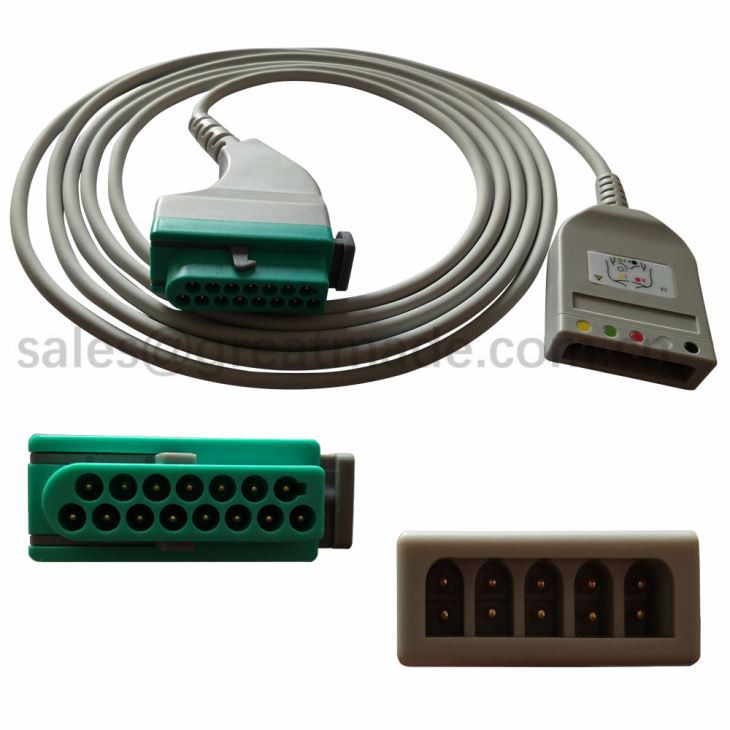

We offer a wide range of Bulk ECG Trunk Cables to meet the diverse needs of our customers. For example, our Compatible Nihon Kohden ECG Cable, 8pin, Din Yoke, 3 - lead, OEC - 6102A is designed to be compatible with Nihon Kohden ECG monitors and provides reliable signal transmission with low capacitance. Our TruLink DIN Neonatal ECG Cable For Spacelabs is specifically designed for neonatal applications, with a compact and flexible design that minimizes capacitance while ensuring accurate signal acquisition. And our Compatible Fukuda DS8100, DS8200, DS8500 5 - lead ECG Cable 15pin is compatible with Fukuda ECG monitors and offers excellent performance with optimized capacitance.
Conclusion
In conclusion, the capacitance of a Bulk ECG Trunk Cable is an important electrical property that can significantly impact its performance in terms of signal transmission and noise immunity. Understanding the factors that affect capacitance and how to measure it is crucial for ensuring the high - quality performance of these cables. As a supplier, we are committed to providing our customers with Bulk ECG Trunk Cables that are designed and manufactured to have optimal capacitance values, ensuring accurate and reliable ECG signal transmission.
If you are in the market for Bulk ECG Trunk Cables or have any questions about capacitance or our product offerings, please feel free to contact us. We are more than happy to assist you in finding the right cable solution for your specific needs.
References
- Grob, Bernard. "Basic Electronics." McGraw - Hill Education, 2007.
- Hayt, William H., Jr., and Jack E. Kemmerly. "Engineering Circuit Analysis." McGraw - Hill Education, 2012.
- Biomedical Engineering Handbook, Third Edition, Edited by Joseph D. Bronzino. CRC Press, 2014.